
f you're still running your wedding planning business on a patchwork of spreadsheets, shared Google Docs, and email threads, you're not alone. But you are falling behind.
The professional planning landscape shifted decisively in 2025 and 2026. According to industry surveys, 36% of engaged couples now use AI tools during their own planning process, up from just 20% the year before. Couples arrive at their first consultation already armed with AI-generated mood boards, vendor shortlists, and rough budgets. If your back-end operations can't match that pace, the gap shows.
The real cost of fragmented tools: Planners running manual systems spend more than 10 hours every week on duplicate data entry alone, copying information between their CRM, client documents, and finance trackers. That's a full workday lost before you've touched a single vendor call.
The good news: a new generation of all-in-one platforms has closed that gap. The challenge is figuring out which one is actually built for how professional planners work, not just how couples plan.
This guide ranks the best wedding planning software available in 2026, explains what separates a real operations platform from a feature checklist, and gives you a framework for evaluating any tool before you commit.
What we evaluated:
All-in-one operations depth (CRM, tasks, finances, contracts in one place)
AI workflow features (genuine automation vs. marketing buzzwords)
Client portal quality (real-time visibility, branded experience, self-service)
Pricing and value for professional studios
Scalability for planners managing multiple events simultaneously
What Makes Wedding Planning Software Worth Switching To
Before the rankings, it's worth naming what separates genuinely useful platforms from glorified contact managers. Most software in this category markets itself as "all-in-one," but the definition varies wildly.
The five features that actually matter for professional planners
Feature | Why it matters | What to look for |
|---|---|---|
Unified CRM + project management | Client data and event tasks live in one place, no copy-paste | Linked contacts, events, and task boards |
Client portal | Couples get real-time visibility without constant email check-ins | Branded portal, document access, payment integration |
AI workflow automation | Reduces admin time on scheduling, follow-ups, and document drafts | Actual automation, not just a chatbot |
Financial management | Invoicing, budgets, and supplier payments tracked in one view | Budget vs. actual tracking, payment processing |
Integrations | Connects to tools you already use (Gmail, Google Drive, Calendly) | Native integrations, not just Zapier workarounds |
The test worth running before you sign up: Can you manage an entire wedding, from first inquiry to final invoice, without leaving the platform? If the answer is no, you're still managing a tool stack, not a system.
The platforms below are ranked with this framework in mind. Tools built for couples (vendor discovery, guest lists, registry) are excluded. This list is for professionals running a business.
The Best Wedding Planning Software for Professionals in 2026
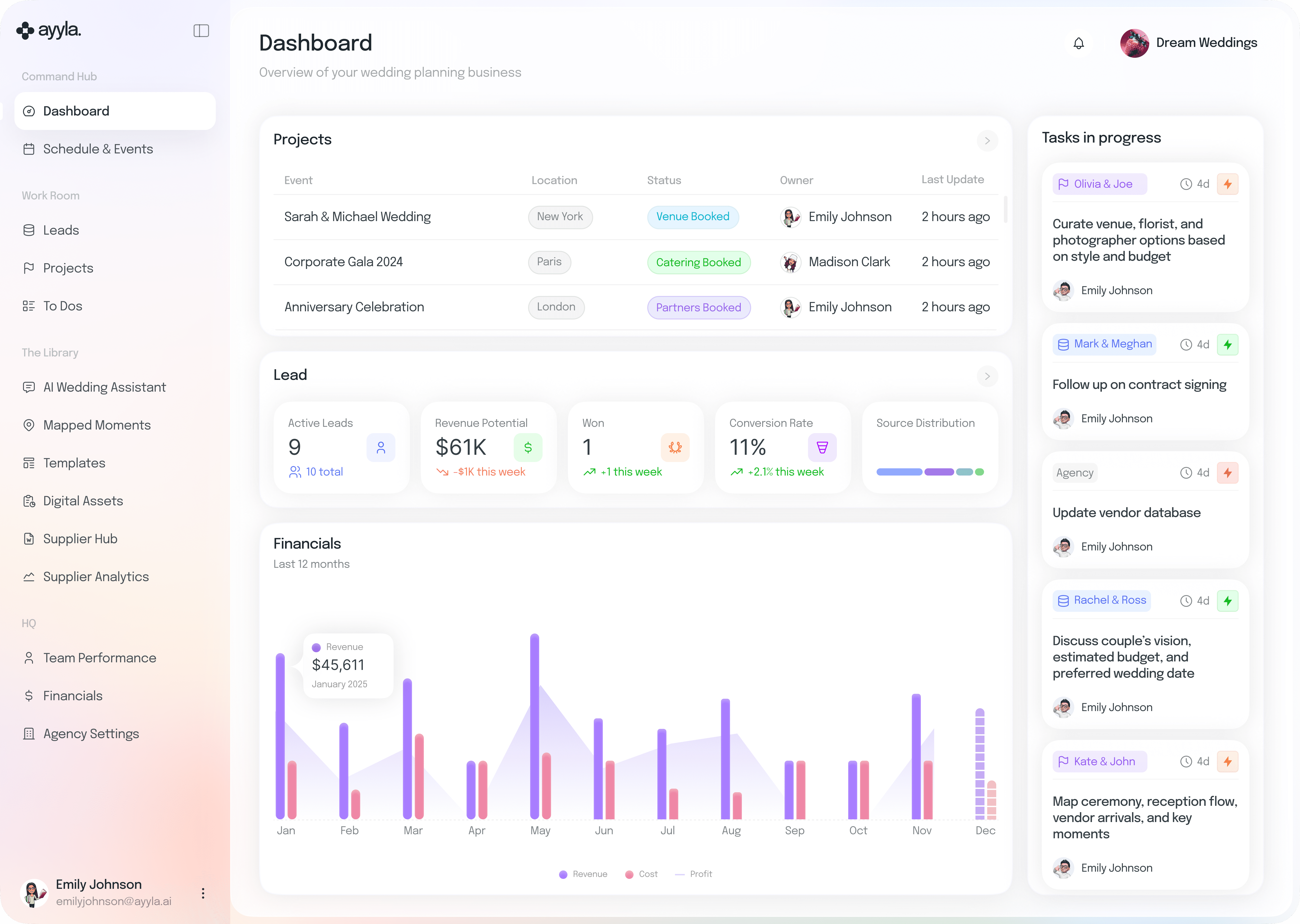
1. Ayyla - Best All-in-One AI Operating System for Wedding Planners
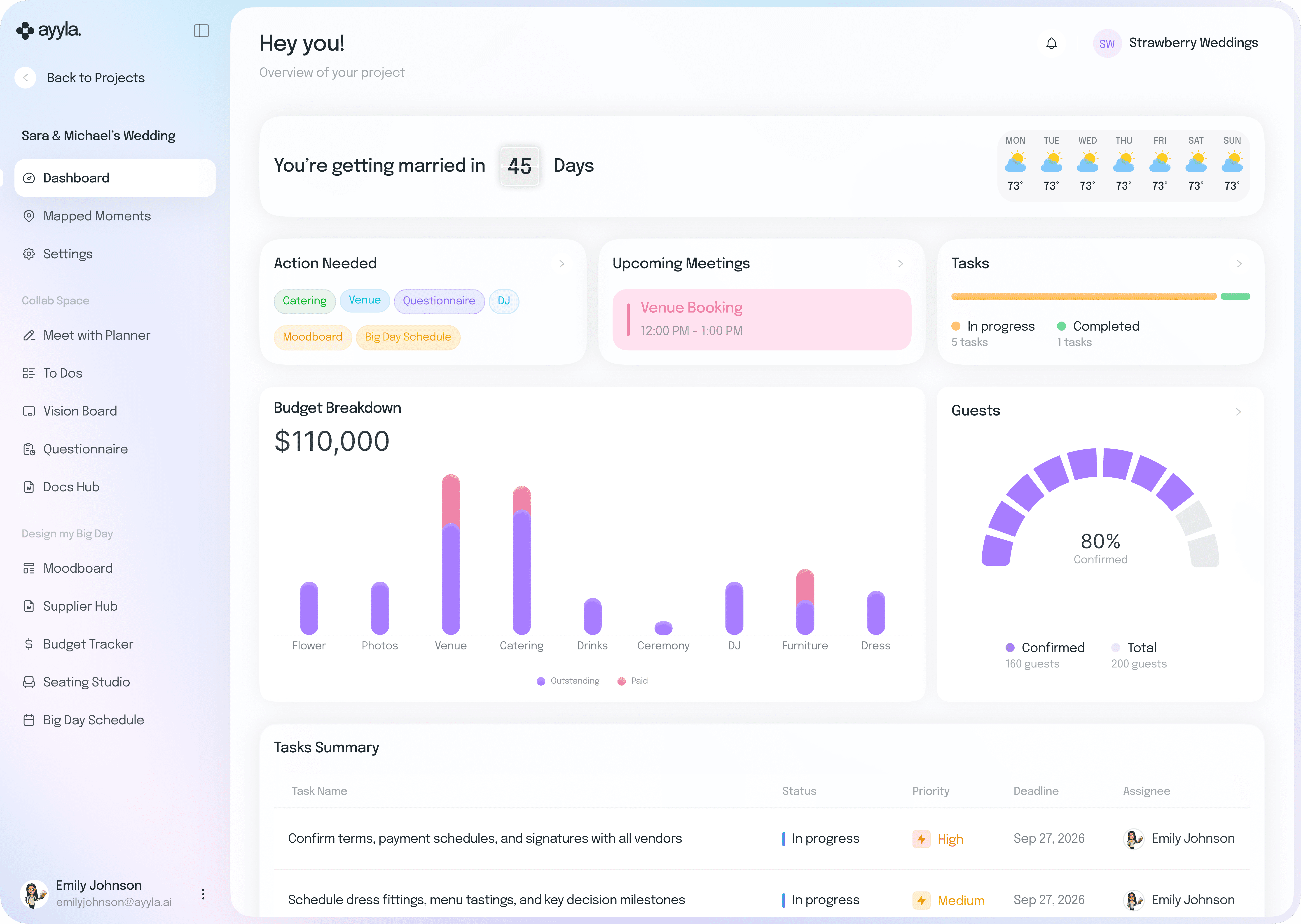
Ayyla is built from the ground up for professional wedding planners and studios, not adapted from a generic CRM. The platform combines event management, client portals, supplier coordination, contract management, and financial tracking in a single workspace, with AI automation woven throughout rather than bolted on.
What sets it apart: Ayyla's client portal gives couples real-time visibility into their event, reducing the back-and-forth that consumes planners' days. The platform integrates natively with Gmail, Google Drive, Calendly, and Pinterest, meaning your existing workflow doesn't get thrown out. AI features handle task automation, follow-up scheduling, and document drafting so planners can stay focused on the creative and client-facing work that actually requires a human.
Best for: Full-service wedding studios and planners managing multiple events simultaneously
Standout feature: AI-powered command center that connects every part of the business
Pricing: Solo $75/month, Studio $120/month, Agency $199/month - all with a 14-day free trial, no credit card required
Integrations: Gmail, Google Drive, Calendly, Pinterest
The bottom line: If you're looking for a platform designed specifically to replace the spreadsheet-and-inbox model, Ayyla is the closest thing to a purpose-built operating system for professional planners available today.
2. Ripluo - Best for AI-Driven Schedule and Budget Generation
Ripluo has built its identity around its AI assistant, Buildr, which automates the generation of event schedules and budgets. For planners who spend significant time building run-of-show documents and financial projections from scratch, this is a meaningful time-saver. As noted by Venue Preview, Ripluo "combines project management, CRM, client-facing documents, and financial tools in a single workspace."
Best for: Planners who need fast, AI-generated event timelines and budget drafts
Standout feature: Buildr AI assistant for automated scheduling and budget creation
Pricing: 0.5% payment processing fee model
Watch out for: Less depth in client portal features compared to dedicated portal-first platforms
3. Aisle Planner - Best for Structured Project Management
Aisle Planner has been a go-to for wedding professionals who want structured, template-driven project management. Its strength is in the planning workflow itself: detailed checklists, customizable timelines, and a library of wedding-specific templates that help planners standardize their process across multiple clients. Unlimited client sites are included across plans.
Best for: Planners who want a proven, template-rich project management workflow
Standout feature: Unlimited client sites with wedding-specific templates
Pricing: From $29/month
Watch out for: AI features lag behind newer entrants; less emphasis on financial management depth
4. HoneyBook - Best for Solo Planners Focused on Client Experience
HoneyBook is the most polished platform in this category from a branding and client-experience perspective. Its interface is clean, onboarding is fast, and the client-facing experience is well-designed. HoneyBook AI, available on Essentials plans and above, drafts emails and automates administrative tasks, making it genuinely useful for solo planners who wear every hat.
Where it falls short for studios: HoneyBook is optimized for the solo operator. Team collaboration features only unlock on the Premium plan, and the platform lacks the deep project management structure that multi-event studios need. Expert reviews consistently note it's "best for ease of use, branding, and client experience" but not for complex operational depth.
Best for: Solo wedding planners focused on a polished client experience
Standout feature: HoneyBook AI for email drafting and admin automation
Pricing: From $39/month (Essentials+)
Watch out for: Team features require Premium; not built for high-volume studios
5. Dubsado - Best for Customization and Workflow Flexibility
Dubsado earns its reputation as the most flexible CRM in the wedding space. Planners who want to build highly customized workflows, form sequences, and client journeys will find more room to configure here than almost anywhere else. The trade-off is a steeper learning curve: Dubsado rewards the time investment but can feel overwhelming out of the box.
Best for: Tech-comfortable planners who want full control over their client workflow
Standout feature: Deep workflow automation and form customization
Pricing: From $35/month
Watch out for: Setup time is significant; not ideal for planners who want a ready-to-use system
6. Planning Pod - Best for Multi-Event Venues and Large Studios
Planning Pod is built for volume. Its strength is managing multiple events simultaneously with lead management pipelines, client portals, and detailed event timelines. It skews toward venues and larger planning operations rather than boutique studios, but planners running high-volume businesses will appreciate the operational depth.
Best for: Large studios and venue-based planners managing many events at once
Standout feature: Lead management pipeline with client portal integration
Pricing: Tiered by event volume; contact for current pricing
Watch out for: Interface density can slow down day-to-day use for smaller teams
7. Plutio - Best Budget Option for Lifecycle CRM
Plutio is the most affordable full-featured option on this list at $19/month. It covers the CRM lifecycle from lead to invoice and works well for planners who need a structured system without the price tag of more specialized platforms. It is not wedding-specific, which means some setup is required to adapt it to planning workflows.
Best for: Budget-conscious planners who need CRM and invoicing without wedding-specific features
Standout feature: Full lifecycle CRM at the lowest price point on this list
Pricing: From $19/month
Watch out for: Not built for wedding planning; lacks event-specific templates and portal features
8. Airtable / ClickUp - Best for Planners Who Want to Build Their Own System
These are not wedding planning tools. But they appear on this list because a significant number of planners use them as spreadsheet replacements, and it is worth addressing directly. Airtable and ClickUp offer powerful organizational features and are highly customizable. The problem: they require substantial setup to function as a planning system, they have no native client portal, and they offer no wedding-specific workflows or financial management.
Best for: Highly technical planners who prefer building their own system from scratch
The honest take: If you are considering Airtable or ClickUp as your primary planning platform, you are trading setup time and ongoing maintenance for flexibility. For most professional planners, a purpose-built tool will save more time in the long run.
Quick Comparison: Which Tool Fits Your Business?
Platform | Best for | Starting price | AI features | Client portal |
|---|---|---|---|---|
Ayyla | Full-service studios, multi-event ops | From $75/month | Yes, native | Yes, branded |
Ripluo | AI-generated timelines and budgets | 0.5% fee | Yes (Buildr AI) | Limited |
Aisle Planner | Template-driven project management | $29/month | Basic | Yes, unlimited |
HoneyBook | Solo planners, client experience | $39/month | Yes (HoneyBook AI) | Yes |
Dubsado | Customized workflows, flexibility | $35/month | Limited | Yes |
Planning Pod | High-volume studios and venues | Contact for pricing | Limited | Yes |
Plutio | Budget-conscious, lifecycle CRM | $19/month | No | No |
Airtable / ClickUp | Build-your-own systems | Free tiers available | No | No |
The pattern worth noting: The platforms with the strongest AI features and the most complete client portals are not the cheapest. But the 10+ hours per week recovered from eliminating manual data entry pays back a $75/month subscription in the first week of use.
How to Choose: Three Questions Worth Asking Before You Switch
Switching platforms is a real disruption. Before committing, answer these three questions honestly.
1. What is your biggest operational bottleneck right now?
If your answer is "client communication and chasing approvals," prioritize client portal quality. If it's "I spend hours on timelines and documents," prioritize AI automation. If it's "my finances are scattered across three tools," prioritize financial management depth. The best platform is the one that solves your actual constraint, not the one with the longest feature list.
2. Are you a solo planner or running a studio?
This distinction matters more than most comparisons acknowledge. Solo planners can get significant value from HoneyBook or Dubsado. Studios managing multiple planners and simultaneous events need a platform that supports team collaboration, multi-event views, and role-based access. Choosing a solo-optimized tool for a growing studio is a common and expensive mistake.
3. Do you want a ready-to-use system or a configurable one?
Some planners want to open a platform and start working within a day. Others want to build exactly the workflow they have in their heads. Aisle Planner and HoneyBook lean toward ready-to-use. Dubsado leans toward configurable. Ayyla is designed to be operational quickly while still adapting to how your studio works.
Bottom line: There is no universally best tool. There is a best tool for your business size, your workflow complexity, and the client experience you want to deliver. Use this list as a shortlist, not a final answer.
The Spreadsheet Era Is Over
The planners who will win the next three years are not the ones with the most experience. They are the ones whose operations can scale without adding proportional overhead. Every wedding you take on without a system that handles the admin automatically is a wedding where your margin shrinks.
The platforms on this list exist precisely to solve that problem. Most of them will save you time from day one. The best of them will change how your business runs entirely.
If you manage multiple weddings and want a platform built specifically for how professional studios operate, start a free trial at ayyla.ai. It is the only tool on this list designed as a complete AI operating system for wedding planners, not a generic CRM with a wedding skin.
14-day free trial, no credit card required. See what running your business from a single command center actually looks like.