A vendor is booked. The budget needs updating. A questionnaire comes back. The timeline needs those answers. A payment is due, and someone needs to follow up.
One decision creates work in three different places.
Multiply that by every vendor, every change and every wedding you’re managing.
Wedding planning business automation should take care of the work that follows a decision, not add another system for you to manage.
The question isn’t how much of your business you can automate. It’s which tasks need your attention and which ones your software should already be handling.
What should wedding planners automate?
Start with tasks that are repetitive, predictable or involve transferring information between systems.
Templates give you a reusable starting point. Automation carries out a defined action, while AI prepares or summarizes information for you to review. A planning workflow may use all three, but they do not replace the same work.
Worth automating | What still needs your expertise |
Inquiry acknowledgments | Assessing whether a couple is the right fit |
Reusable onboarding workflows | Personalizing the planning experience |
Recording confirmed vendor costs | Negotiating and approving bookings |
Summarizing questionnaire responses | Understanding the couple’s priorities |
Building timelines with AI | Refining the flow and logistics |
Payment reminders | Handling sensitive financial conversations |
Sharing current planning information | Guiding decisions and managing expectations |
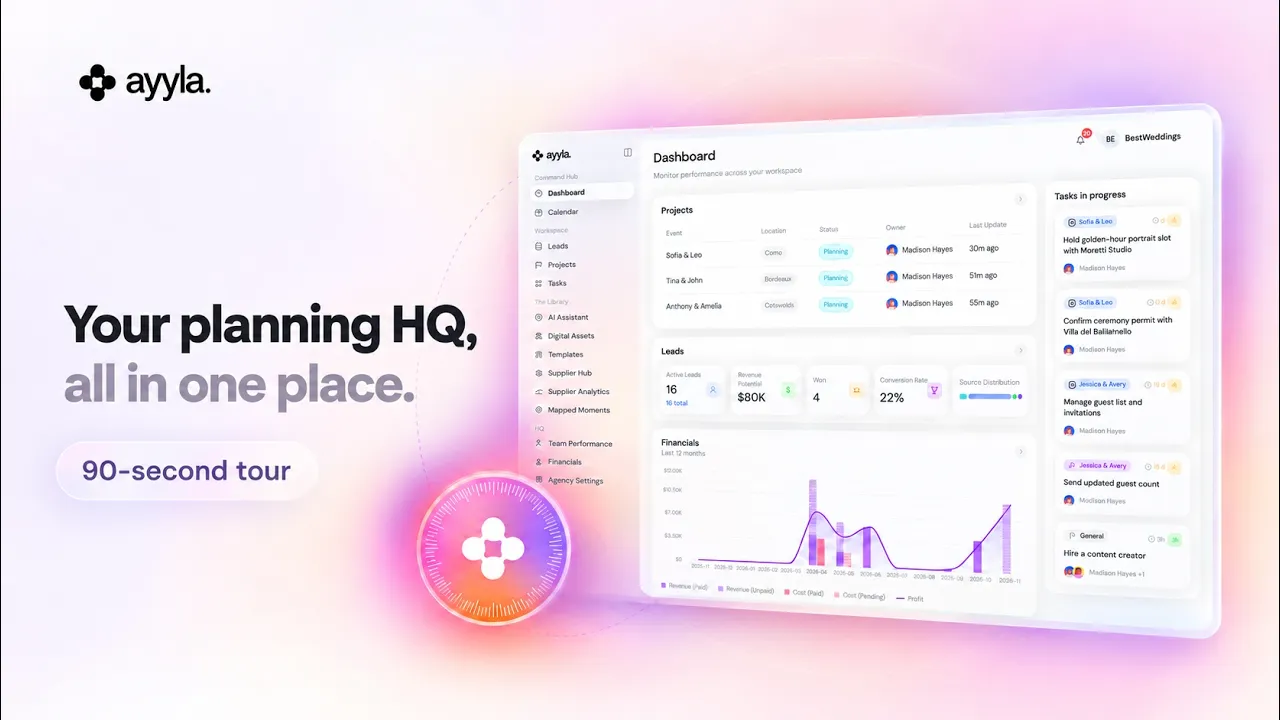
A 90-second overview of how Ayyla brings planning workflows, client collaboration and project context into one place.
1. Stop rebuilding the beginning of every wedding
A new inquiry comes in while you’re visiting a venue.
An automated acknowledgment can confirm receipt and set expectations without promising availability or committing to a service before you’ve reviewed the details.
Once the couple books, reusable questionnaires, task lists and documents give you a consistent starting point.
In Ayyla, you can create templates for recurring planning workflows and adapt them to each wedding.
A destination wedding, a multi-day celebration and a coordination-only booking may require different approaches. Your process should accommodate those differences without making you rebuild everything from scratch.
2. Let vendor bookings update the budget
A vendor is confirmed. You’ve agreed on the fee, payment terms and services.
Why should that information need to be entered again?
The booking becomes part of the wedding’s financial picture without duplicating the work.
Ayyla also keeps the couple’s wedding budget separate from your agency’s finances.
Through Ayyla Financials, business owners can track planner fees, supplier commissions, expenses, revenue and profitability across projects.
Automatic reminders for planner-fee installments can also take routine payment follow-ups off your list.
The numbers stay connected to the work that generates them.
3. Put questionnaire answers to work
Questionnaires capture some of the most important information about a wedding.
Preferences, priorities, family considerations, traditions and details that will influence decisions throughout the planning process.
But collecting that information is only useful if it continues to inform the work.
Those responses also become part of the wedding’s context. When you use Timeline Agent, the answers inform the schedule alongside booked vendors, event details and your instructions.
Information collected at the beginning of the planning process doesn’t need to be reconstructed every time it’s relevant.
4. Build wedding timelines with AI that already knows the wedding
A wedding timeline depends on much more than ceremony and reception times.
There are booked vendors, venue restrictions, travel, setup requirements, family portraits, cultural traditions and dozens of details that affect one another.
With Ayyla’s Timeline Agent, that context is already available.
Click “Build It With Me” and speak or type your instructions.
For example:
“The ceremony starts at 5 PM. We need family portraits before the reception, and guests need time to travel between venues.”
Ayyla combines your instructions with questionnaire responses, booked vendors and the wedding’s existing details to build a timeline tailored to the event.
You can adjust timings, refine the flow and coordinate multiple celebrations. You can also begin with a template or create a timeline from scratch.
You’ve already done the work of understanding the wedding. Ayyla puts that knowledge to work.
Review the draft against confirmed venue access, travel times, vendor requirements and the couple’s priorities before approving it.
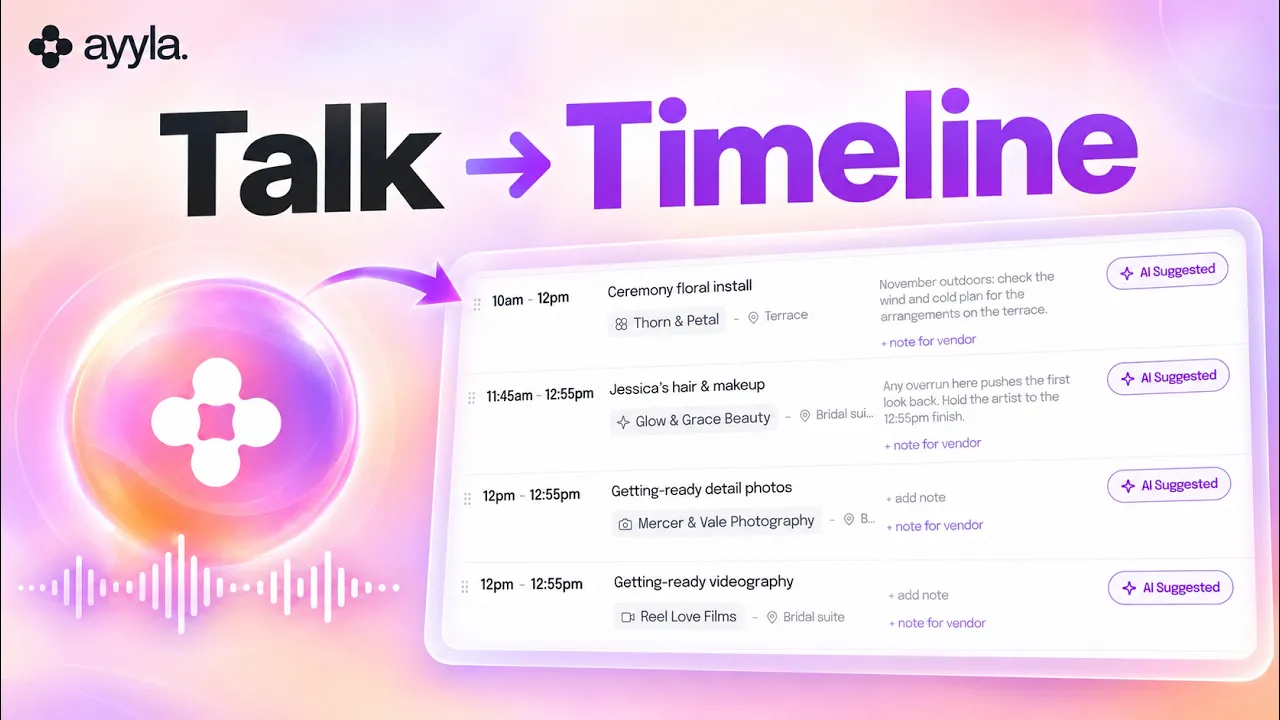
See how Ayyla’s Timeline Agent turns voice or text instructions and wedding project details into a draft timeline for planner review.
5. Keep planners and couples connected in real time
Ayyla connects planners and couples through two dedicated workspaces.
Planner HQ is where you manage your business, including leads, projects, teams, tasks, vendors and operations.
The Couple Workspace is where you and your couples collaborate in real time on shared tasks, questionnaires, budgets, vendor selections, seating arrangements, documents and more.
You decide what’s visible, keeping private agency work separate from what you share with each couple.
Everyone works with the same connected plan, without having to search for the latest information.
Your couples stay involved. You stay in control.
What should never be left entirely to automation?
The most valuable part of wedding planning has never been the checklist.
It’s the judgment behind every decision.
Couples trust their planner’s taste, experience and ability to anticipate what they haven’t thought of. They rely on someone who can manage competing priorities, navigate difficult conversations, protect the creative vision and remain composed when plans change.
A great planner knows when to intervene, when to reassure and when to quietly solve a problem before anyone else notices.
There’s an instinct to that work. A sensitivity to people, timing and detail that comes from experience.
That combination of judgment, trust, finesse and creative direction is the art of wedding planning.
Technology can coordinate information and execute workflows. But the experience a planner creates for a couple goes far beyond either.
The real opportunity is a connected planning process
Automating individual tasks is useful.
But automating tasks across disconnected applications still leaves someone responsible for keeping everything together.
A vendor booking affects the budget. Questionnaire answers inform the timeline. Changes to the schedule affect the people and vendors involved.
These aren’t separate processes. They’re different parts of the same wedding.
The result is more than fewer manual updates. It’s a planning process that can keep moving without asking you to reconnect the pieces.
See what happens when everything works together.
Discover Ayyla, the AI operating system for professional wedding planners.
Start your 14-day free trial. No credit card required.
Tina Daher, Cofounder of Ayyla
Tina co-founded Ayyla to build the kind of technology professional wedding planners deserve: a system that understands the complexity of their work and helps them stay focused on what matters most.
October 21, 2026